The Bat Plant

 Tacca chantrieri

The Bat Plant

Family: Taccaceae

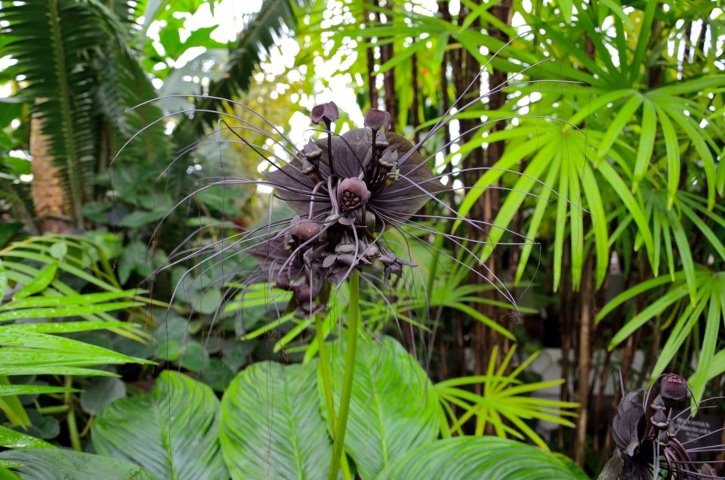
Among the lush greens and vibrant reds of the tropical forest lurks one of the most unusual plants of the world: Tacca chantrieri, or The Bat Plant. Named for its black bat-like flower that grow up to 12 inches across, The Bat Plant could also be nicknamed The Black Cat Plant for its distinctive long “whiskers” that can grow over 2 ft. long. Other common names include The Devil Flower, Bat-Head Lily, and Black Tacca.

The most common Bat Plant is the beautiful blackish variety, although there are actually several colors including a very ghostly white flowering variety. This amazing rotanical is more than just a fun freak of nature–recent evidence shows that it may actually have cancer-fighting properties. According to an article on this website:

The Therapeutics Program at the University of Texas Health Science Center at San Antonio, has been working to isolate substances in the plant in hopes of finding a new  plant-derived cancer drug with the potential of Taxol. Taxol, the first microtubule  stabilizer derived from the Yew family, has been an effective chemotherapy drug, but patients eventually develop problems with resistance over time and toxicity at higher doses. Researchers have long been seeking alternatives. “We’ve been working with these for years with some good results, but never with the potency of Taxol,” said Mooberry, lead author of the study. “Now we have that potency,  and we also show for the first time the taccalonolides’ cellular binding site.”

In other words they have isolated something as effective and powerful as Taxol in the beautiful bewitching bat plant. Go rotanical, go!

Want to grow your own super-freak? If you live in a steamy, humid climate you should have no problem. You can just let it go wild. But for the rest of us, even in my mild SF garden, you’ll need to do it in a pot in a greenhouse most of the year. If it gets below 40 degrees they get very, very cranky. Shade or bright indirect light. Why would a bat like the sun?

Height: About 18-20” with flowers of several inches. Remember the whiskers, though, which can dangle down to the ground!

Hardy to 40 degrees.

Note: this amazing photo came from my cousin Anne Mackin who snapped it at the SF Conservatory of Flowers. They have a regularly blooming Bat Plant!!
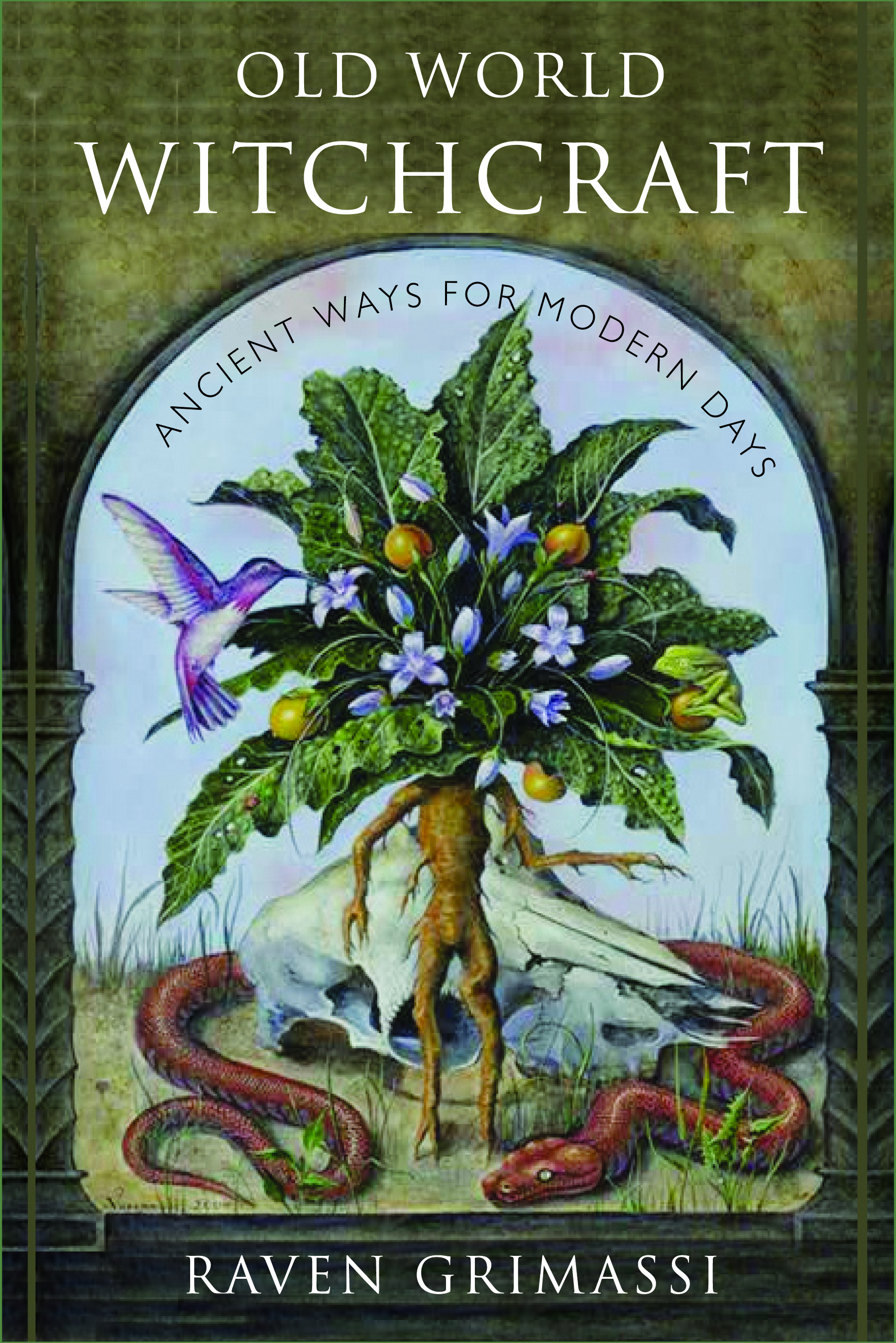
Raven Grimassi is a plant witch. He is a world-renowned author on witchcraft, folklore, Wicca, and Neopaganism whose most recent book, Old World Witchcraft, addresses something he refers to as the organic memory of the earth. He is a spiritual botanist–that is to say he goes beyond the medicinal or ethnobotanical uses of a plant and works with the spirit and the consciousness of the plant. In particular, he works with what we may all consider traditionally “witchy” or dark plants–rotanicals such as Aconite, mandrake, and hemlock. I was fortunate enough to have been introduced to Raven in Salem, Massachusetts a couple of years ago and to work with him as this book came out. I recently interviewed him.

What is your earliest plant memory?

This question brings back fond memories.  When I was around five or six years old, my mother had an herb garden in the backyard.  She would often call me over, show me a plant, and then ask “Did I ever tell you what we do with this plant?”  This was always a learning opportunity.  Here was the beginning of my interest in herbs and my understanding that they possessed abilities to influence things.

In Old World Witchcraft you introduce readers to the Ash, Birch, and Willow magical system. Can you describe this?

It’s a system that, in part, is designed to link people with the sentient nature of plants and the spirits that inhabit them.  At the core is a desire to be linked to the Green Wood in intimate ways, as were our ancestors before the time that humans moved towards mastering Nature as opposed to living in common cause with Her.

The practice is intended to establish communication on inner spiritual levels with the consciousness of the living plant life within Nature.  This is done through a variety of techniques such as meditation, conscious dream work, and the use of plant symbols that open direct channels to the Green Wood.

You speak of the organic memory of the earth. Where do plants and plant magic fit in with this memory?

Yes, the idea is that every living thing that died upon the earth had its essence absorbed into the soil.  The memory of each is contained in the mineral composition of the earth, what we call the “bone memory” of the Land.  We know scientifically that crystallized minerals can store, transmit,  and direct energy.  Plants absorb minerals through their root system, and the associated magical belief is that plants therefore can tap into the organic memory of the earth.   This makes it possible to extract memories from the earth when we work closely with plants and their spirits.

The book cover has an image of the mandrake on it. What is the significance of the mandrake?

Poetically speaking, the mandrake is the plant that dreamed of being human, and therefore its roots took on a humanoid shape.  Because we view the mandrake as part plant, part human (in the mystical sense) we think of it as a bridge between humankind and the Green Wood Realm.  In this way the mandrake is a mediator between the worlds.  Therefore we rely upon it to help with spirit contact and as an ally when working with plant spirits.

Do you have a favorite plant?

I have several that call to me in different ways and on different levels.  I like the mandrake because of its direct connection to humankind, and have grown them for many years.  The foxglove enchants me and I love its flowers.  Aconite is another plant that I love for its potent energy that it emanates – it is quite mystical.

What is growing in your garden right now that you are especially proud or fond of?

Well, all the traditional plants of Witchcraft, of course!   I grow them all: aconite, henbane, hemlock, hellebore, belladonna, and foxglove.  These plants surround a rose bush that represents the spiritual teachings of my personal tradition.   I also recently planted seedlings from selected trees that have legends associated with them:  rowan, hawthorn and blackthorn.

Learn more about Raven Grimassi at his website: www.ravengrimassi.net

Cover artist for Grimassi’s book is Benjamin A. Vierling. Look for an upcoming Rotten Botany interview with Vierling and his botanical alchemy!

Also be sure and watch for future entries on all of the above mentioned wickedly wonderful plants!

Corokia cotoneaster ‘Little Prince’ 

Also called: Wire Netting Bush

Family: Cornaceae

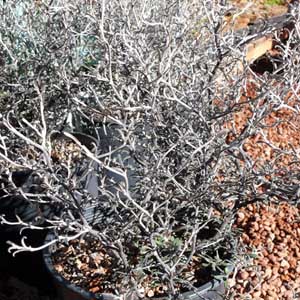
One of the most unusual plants growing in my garden is the gnarled, twisted little shrub Corokia cotoneaster–what I like to refer to as “The Nightmare Before Christmas Tree.” Grey leaves growing upon black, zig-zagged stems may lead the untrained eye to think that this member of the Dogwood family is already dead. Prune it back to showcase its twisted form and add a little up lighting and you can get a spooky effect worthy of the most haunted of houses!

Macabre beauty aside, Corokia often appears in groomed commercial landscaping with golden cypress and crimson Japanese maples because of its contrasting color and interesting shape. ‘Little Prince’ is my personal favorite variety because its stems seem to be particularly black, and it grows much slower than the other varieties (it is a dwarf) and therefore lends itself very nicely to container gardening.

This plant looks amazing on a little mound, surrounded by a green moss or chartreuse Selaginella and circled with Black Mondo grass. It does produce small yellow flowers (not showy) followed by tiny berries, but again these are what we’d call in the botanical world “insignificant.”

Hardy to most climates, I’ve seen it in the dead of winter reaching out from a snowy bed like a skeletal finger.

Culture~

Height: 3-4 ft .

Hardiness:

Hardy to 20 degrees and I’ve seen it in the dead of winter reaching out from a snowy bed like a skeletal finger!

Full sun in milder climates, plant it in a shadier spot if you live somewhere that gets extra hot. Can survive pretty well in either!

Native to New Zealand.

Dracula Orchids

This last weekend I dragged the whole little family down to the Pacific Orchid Expo at Fort Mason in San Francisco. It was a glorious day to be down by the water with the sun shining and the waves lapping at the piers, a soft breeze rippling off the crisp February bay. But the real beauty that day was inside!

There were THOUSANDS of amazing orchids (more pictures on Rotten Botany Facebook page) but being the Rotten Botanist the main reason I went to this show was to see what kind of Dracula orchids might be lurking about. And I have to admit (no offense to the gorgeousness of the Dendrobiums, Oncidiums, and award-winning Masdevallias) I felt pretty nonchalant about the rest of the show once I’d gotten my Dracula-fix!

The majority of the Dracula orchids at the show were in this large glass coffin of a display case, hosted by the SF Bay Area Pleurothalid Alliance. (Draculas are a member of the sub-tribe of Pleurothalids, along with Masdevallias but are a separate genus from Masdevallias) This fantastic display housed dozens of beautiful hanging plants oozing with dark flowers and tendrilly bits, shrouded in misty bursts of simulated fog.

Draculas are New World orchid genus that include over 100 varieties, the highlight of which may well be the infamous Dracula vampira.There is even a variety of Drac vampira known as ‘Bela Lugosi’ for those of you who are aficionados of all things dark and rotanical. I’ll include a future entry on this specific species, but this time round one of the show stoppers was Dracula Raven ‘Mad Hatter’. This velvety ruddy beauty was suspended among many other prize Dracs, but stood out for its sheer girth. My other favorite was the Dracula ubingina ‘Juan’ which looked like it could actually take a bite out of you.

The majority of Draculas are not native to Transylvania but rather Ecuador, with Columbia and Peru also hosting a wide variety. Their preference for dark, shadowy forests and cool, misty temperatures are perhaps what have earned them their name.

Ah, the most marvelous Dracula orchids! How vicious they look, how wickedly wonderful they are!

A New Rotanical Discovered!!!

A new species of Amorphophallus has recently been discovered !!! It isn’t quite as big as The Corpse Plant  (A. titanum)but seems to be just as wretched in scent. Amorphophallus perrieri possesses the unique adaptation of releasing a smell like death to attract pollinators like carrion beetles and flies just as its cousins the Corpse Plant and the Devil’s Tongue (A. konjac).

Growing some five feet big this thing could stink up the whole island of Madagascar where it was discovered. Apparently the botanist, Greg Walhert, was looking for violets when he happened upon this horror! What an amazing find.

Wahlert and his lab partner are affectionately referring to it as a Porta Potty Flower. Clearly this is a true rotanical deluxe.

You can read more about it here:

New “Porta Potty” Flower Discovered.

Salvia discolor

Andean Sage

Family: Lamiaceea    

Salvias are one of the more amazing plants. There are dozens of varieties, all of which have different color blooms: red, white, turquoise, purple, chartreuse. But nothing could be cooler than the salvia that blooms black. That’s right! There is a BLACK BLOOMING SALVIA which has earned the name Salvia discolor. 

A tender perennial, Salvia discolor thrives in the local Bay Area climate but being a native to Peru it can manage in a variety of climates and winters over nicely with the proper mulching. The leaves are mossy green and the stems brilliantly silver, contrasting with the deep purpled blackness of the blooms. It has a pleasant acrid smell, not unlike your common household sage. The leaves do have a sticky quality, which earns it the nick name “fly paper sage”.

I had been an admirer of this unusual salvia for its ability to surprise even the most seasoned gardener with its striking flowers and was riding home on the N Judah one evening, proudly bearing my newest 4″ S. discolor which I had purchased just that afternoon via special order at The Scarlet Sage. The Scarlet Sage is San Francisco’s only herbal apothecary with decided witchy undertones and one of my all time favorite shops. In the spring you can count on them to have a fine selection of medicinal and edible plants, and they kindly special ordered my discolor. A woman sitting in front of me asked me what the plant was and what it was for and I had to admit I only knew the botanical basics. As far as I knew it wasn’t used in cooking or medicine, its value being in its unusual colored flowers. Just then a slight woman sitting next to her piped up. Like Salvia discolor, this woman was a Peruvian native and gladly informed me that this plant is used in Peru much like we use the common sage in cooking–beans, meats, stews. (Thank you public transit for the ethnobotanical opportunity!) The stickiness and pungent smell suggests that there is even more to this plant than meets the eye–so if anyone out there knows more about its medicinal properties let us know! Many sages are used to treat mild stomach upset and aid digestion.

Like all sages, Salvia discolor attracts pollinators to your garden–bees, butterflies, small birds–so it is an invaluable asset. Plus it looks really freaking cool, its wild and wiry spindles of silver and black writhing up from the shrubbiness of its green leaves. Even though it is a bit sticky, it looks great in floral arrangements too, especially with white roses. Another true rotanical!!

It is also drought resistant and needs little care once established! A bonus for those of us who tend to gardens that thrive on neglect. Below is a photo from the flickr commons. I will upload more pictures of my own discolor in the coming weeks. In addition there is a wild and wooly garden near my house with an abundant S. discolor just begging to be featured on Rotten Botany! 

Salvia discolor photo by Scott Zona, taken from flickr commons.

Culture~

Grows from 1 to 3 ft high and wide. Water regularly to establish and then infrequently. Likes full sun unless in an extremely dry and hot climate, then give partial shade. Hardy to 10 degrees though I would advise mulching with straw or something similar if you are in an area of heavy snow.

Amorphophallus Amungus

A quick note to let you know that the Conservatory of Flowers in San Francisco currently has a blooming stinky amophophallus. I am not sure what variety, but it does not appear to be a titan arum. There are more than 150 plants known as amorphohallus so I will report back on the exact kind when I return, and I will post pics too! 

It’s a rare, er, treat to see and smell one of these fantastic and foul beauties. They only bloom for a few days at most so you have a pretty brief window. And some species go for years in between blooms. 

Mondo Bizarre-O

               Black Mondo Grass

     Ophiopogon planiscapus ‘nigrescens’ 

 Family: Liliaceae

There is nothing quite as creepy as a sprawling planting of Black Mondo Grass. It looks like a lawn of  spider legs, undulating from the earth, dark as night. This is not the kind of lawn you hide Easter Eggs in. This is the Devil’s carpet!

Sometimes also called Black Lily Turf or Black Dragon Grass this extremely hardy plant is, to my knowledge, the ONLY truly black plant on earth. Most flowers and petals or leaves of “black” plants are deep maroon or purple when held to a spot of sunlight. Not so the Black Mondo! No light penetrates this beautiful blade.

Not a true grass but actually a member of the Lily family, the Black Mondo Grass is the cousin of the well-known soldier of the busy landscaper, Liriope. Lirope is an ol’ standby for many gardeners, especially in commercial plantings, because it is shade tolerant and hardy, forgiving of trash and dogs, and overall a fairly attractive (if overused) plant. There was an attempt to reinvigorate Liriope’s popularity a few years ago with a flashy new variegated hybrid, but I digress…

For the average climate Black Mondo Grass does well planted in a shade or partial shade setting. In San Francisco’s foggy but consistent climate this does fine as a sun plant, providing the exposure is primarily morning sun. A north or northeastern facing place is excellent. With a bit more sunlight the blades get wider and the fairly slow-growing Black Mondo thrives. A lot of botanical sites say that this plant can take full sun but I would caution you not to put it into  blazing afternoon sun unless you want Black Mondo to become Brown Mondo.

It does get small flowers that give way to a beautiful blue-black fruit. This is pretty small, though, and not all that showy but another cool feature of an already insanely cool plant.

This is an excellent planting for small spaces and container. To emphasize its spidery qualities, plant it in a container edge so it looks like it is crawling over! My friend Bill Barnett at Sloat Garden Center taught me to “Plant the Black Mondo in a cobalt blue pot with Chartreuse Selaginella” for maximum contrast!

Culture:

About 8″ wide by 12″ wide at its maximum. This is a clumping plant that won’t spread or take over your garden. It grows fairly slowly.

Hardy to 0 degrees (yep, ZERO!)

This is a native to Japan. There are a couple of varieties, including ‘Black Beard’ which has wider blades and grows a little faster.

The Corpse Flower

The Corpse Flower

Amorphophallus titanum

Family: Araceae

Ah, The Corpse Plant also called The Corpse Flower, Amorphophallus titanum is the mother of all stinky arums. Often referred to as the Titan Arum, this plant is probably the ultimate Lovely Lily of Death (note: it is not actually a lily.) This plant is ENORMOUS! The leaf can grow up to twenty feet tall and wide, and the flower can grow to be up to nine feet tall. Like its distant cousins, the Voodoo Lily and the Black Calla, the Corpse Plant produces leaves every year but flowers less frequently. Usually it takes seven or so years of producing leaves, sucking up enough energy into the tuber to produce the massive inflorescence (which is actually a many smaller flowers stacked up to make the “one” bloom.)

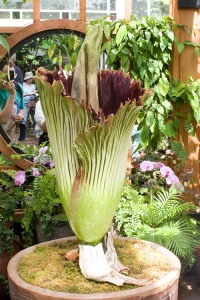
The most distinguishing feature of the Titan Arum is its distinctive smell. When at last mature enough to produce a full fetid bloom beware! This thing smells like a rotting corpse. Probably more like a rotting carcass, like that of a dead whale or seal on a beach, than an actual human corpse, its foul smell also attracts visitors to whatever botanical garden is hosting the stink-party. I was a docent at the Conservatory of Flowers back  in 2005 when Ted the Titan, on loan from the UC Davis Botanical Gardens, bloomed in all its funky glory. People were lined up out the door of the Victorian conservatory just to get a glimpse, or in this case, a whiff. It is truly a sight to behold.

The flower looks like a giant version of the Voodoo or Vampire lily, with a massive spadix jutting out of its delicately ruffled outer petals. It has a blood-red interior and a green outer layer, often streaked with color like dripping blood!

The cultivation of such a plant is only recommended for individuals with very strong stomachs, decent biceps and good backs,  who are also in possession of a very, very large hothouse. It is native to Sumatra and does not like cold temperatures. The tuber alone on a mature plant can be over forty pounds!

Culture~

Height to 20 ft. (Flower to 9 ft.)

Requires warm temperatures, extremely high humidity. Even when dormant, do not expose to temperatures lower than 59 degrees.

This is Ted the Titan from the 2005 bloom at the SF Conservatory of Flowers.

Please note I did not take this photo though this is the same Corpse Flower I was lucky enough to spend time with. I got it from this guys website. He has tons of great photos and I hope he doesn’t mind that I snagged this. Full credit to: http://www.pbase.com/mtpuff/ted

Blog at WordPress.com.

Up ↑